News
Keeping you up to date on news, events and what’s happening at ESG…

Keeping you up to date on news, events and what’s happening at ESG…
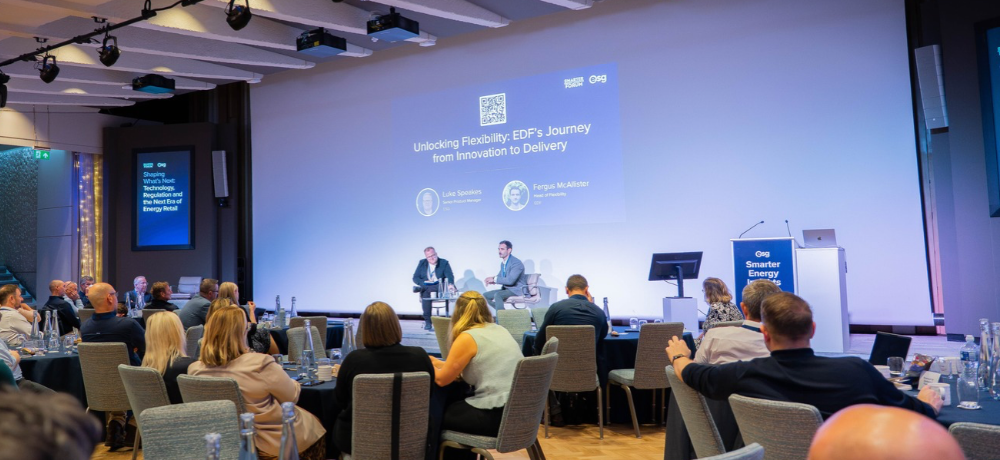
By Luke Speakes, Senior Product Manager at ESG Global
At this year’s Smarter Energy Insights Forum, I had the pleasure of sitting down with Fergus McAllister from EDF Business and Wholesale to talk through Flexibility: where it’s been, where it’s heading, and what EDF’s own journey can teach the wider market.
Flexibility has become one of those topics that crops up in nearly every conversation across the industry right now, whether we’re discussing market reform, batteries, EVs (electric vehicles) or smart tariffs. But as Fergus pointed out, while flexibility itself isn’t new, the pace of change around it has accelerated dramatically.
I wanted to share some of the key takeaways from our conversation, because I think they’re genuinely useful for anyone trying to make sense of where this market is going.
Fergus has spent ten of his twelve years at EDF working specifically in flexibility, so he’s watched this transformation up close. Flexibility used to come from gas turbines and coal, but we’re now firmly in “a world of clean flexibility”: battery storage, behind-the-meter assets, EV smart charging, and heat pumps all contributing demand-side response.
This is all due to the significant growth in renewable and electrification over the past decade or so.
The scale of change is genuinely striking. It was just over five years ago that grid-scale battery storage in the UK stood at less than one gigawatt. Today it’s at eight gigawatts. Individual projects have grown just as dramatically, from six-megawatt schemes to 500-plus megawatt projects with much longer durations.
Regulation has started to catch up too, with many of the barriers to consumer-led flexibility beginning to fall away. As Fergus put it, the industry has moved past proving flexibility works. The question now is how to scale it commercially.
That shift is something my colleagues and I see reflected in the conversations we’re having across the market. Businesses aren’t asking “what is flexibility?” anymore. They’re asking how to scale it, how to access specific markets, and what accreditation is required.
That’s true not just of suppliers, but of independent aggregators, asset owners and PPA operators too.
When I asked Fergus which regulatory changes excite him most, he named three worth flagging for anyone tracking the direction of travel.
The first is locational signals. While zonal pricing didn’t materialise in the form some expected, the Reformed National Pricing arrangements still aim to give stronger investment signals about where flexibility is needed on the system – not just when to flex, but where.
The second is device interoperability, part of the Smart Secure Electricity Systems (SSES) framework. Today, flexibility providers have to build bespoke integrations with individual OEMs one by one, which is expensive and slow. Standardised protocols would let consumers switch flexibility providers far more easily, and free up providers from constant one-off engineering work.
The third is market standardisation, particularly around the role of the market facilitator. Fergus was candid that this is still a relatively new function, and there’s a substantial roadmap ahead in areas like revenue stacking and transparency for consumer-led flexibility.
I’d add a fourth to that list, which came up repeatedly through the day: Market-wide Half-Hourly Settlement. It’s the data bedrock that flexibility ultimately relies on, but it raises real questions for the behind-the-meter space, where MOPs and data collectors continue to operate alongside the shift towards metering and data services.
There’s clearly an interesting period of overlap ahead.
EDF’s flexibility journey started to take shape around 2015, driven by a recognition that renewable growth, market volatility and the decommissioning of coal all pointed towards the same conclusion. As both a major supplier and a large generator with round-the-clock trading capability, EDF had the foundations already in place.
The early focus was demand-side response, largely through Triad management and the Capacity Market. Progress was steady rather than spectacular, as the behind-the-meter market simply wasn’t ready yet. The real turning point came around 2016, with the arrival of the first grid-scale batteries through National Grid’s Enhanced Frequency Response service.
That’s when EDF built out its Powershift capability. It’s the combination of forecasting, trading and people that unlocks value from flexibility. This allowed EDF to begin growing its battery route-to-market business, including flagship revenue floor arrangements to support debt-financed projects. This business now stands at 6GW of contracted batteries, >2GW of which are live and operational.
In 2022, the focus rebalanced again towards behind-the-meter and consumer-led flexibility, aided by new market roles like the Virtual Trading Party, which meant EDF could provide flexibility services across the whole market rather than just for its own supply base.
Acquisitions such as Pod Point, one of the largest charge point operators in the UK, helped build out what Fergus described as an ecosystem: EDF’s virtual power plant now includes 130,000 assets.
One area worth explaining properly, since it came up repeatedly, is the Asset Metering Virtual Lead Party (AMVLP) accreditation, which EDF achieved roughly a year ago working with ESG.
Virtual Lead Party (VLP) status lets an independent aggregator access the Balancing Mechanism without being the supplier of record.
Virtual Trading Party (VTP) does the same for the wholesale market. Both, however, operate at the meter point boundary, meaning other activity at a site can obscure the impact of the flexibility you’re providing.
AMVLP solves that by allowing flexibility to be controlled and measured directly at the asset’s sub-meter, stripping away the noise from everything else happening on site. For EDF, the key driver was modification P483, which allows flexing at the sub-meter even where the boundary meter isn’t half-hourly settled, opening up access to the Wholesale and Balancing Mechanism markets for tens of thousands of assets that haven’t yet migrated to Half-Hourly settlement.
EDF worked with us at ESG using our Titanium FMI (Flexibility Market Interaction) product to achieve this accreditation, which handles the market interaction and asset registration so EDF can concentrate on optimisation, trading decisions and the customer relationship.
We spent some time discussing what all of this delivers for end users, and Fergus set out three consistent benefits.
On the question of behavioural versus asset-led flexibility, Fergus was clear that the market is moving towards asset-led, automated solutions. As he described it, customers don’t want to understand what’s happening behind the scenes any more than they understand how their mobile phone works. They simply want it to work, and to trust that it will.
Fergus laid out the roadmap for us.
The scale of participation the system will need is only going to grow, and virtual power plants like EDF’s Powershift are, in effect, building enormous distributed, virtual batteries out of millions of individual assets.
As Fergus summed it up, the sophistication happens behind the scenes. The challenge for the industry now is making sure the experience at the front stays simple enough that customers trust it.
It was a genuinely illuminating conversation, and one that reinforces something I think most of us in this space already sense: flexibility has moved well beyond proof of concept. The task now is building the regulatory, technical and commercial foundations to scale it properly, and doing so in a way that keeps customers’ trust at the centre of it.