News
Keeping you up to date on news, events and what’s happening at ESG…

Keeping you up to date on news, events and what’s happening at ESG…
This article is based on our webinar “Unlocking Value: Entering the UK Flexibility Market” which was first presented on 19th August 2026.
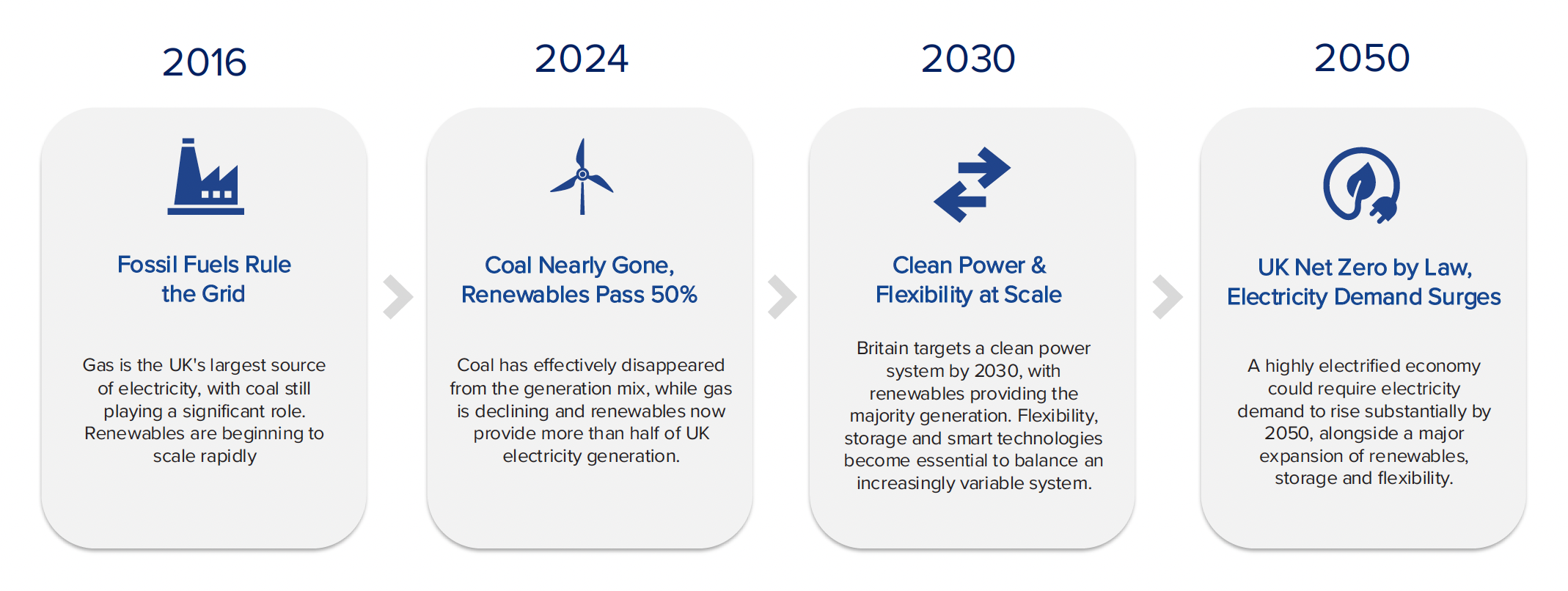
The UK’s energy system is undergoing a profound shift. As coal has all but vanished from the generation mix and renewables now supply more than half of the country’s electricity, balancing supply and demand has become a far more complex task.
Flexibility (the ability to shift, increase or decrease consumption and generation in response to system needs) has emerged as one of the most important tools for managing this transition, and it’s opening up a significant commercial opportunity for suppliers, aggregators and VPP operators alike. We recently covered how organisations can access those opportunities in a webinar, and here is a brief overview of everything we went over.
Rather than building ever more network infrastructure or expensive dedicated generation, flexibility allows assets that already exist to respond intelligently to changing system conditions.
Ofgem has identified flexibility as one of the crucial enablers for the UK to hit its Clean Power 2030 and Net Zero 2050 targets: consumer-led flexibility is expected to grow roughly fivefold in under a decade, from around 2.5 gigawatts today to 12 gigawatts by 2030.
Several forces are converging to make this the moment for flexibility to scale:
The growing demand for electricity from new grid connections, data centres and distributed assets is putting unprecedented pressure on the grid, while renewable generation remains intermittent. Flexibility is becoming essential to balance when and where power is generated and consumed.
It’s no longer just about dispatching large batteries. Increasingly sophisticated methods for aggregating smaller assets into larger tradeable portfolios are emerging. For example, Ofgem reports that 11 million UK Electric Vehicles, with 50% Vehicle-to-Grid (V2G) enabled, could provide approximately 16GW of daily flexible capacity. While the innovations around V2G are still being explored, the potential opportunities should be clear.
More businesses are entering the flexibility markets. As an example, Demand Flexibility Service usage has grown by 50% since its launch in winter 2022, and businesses are developing increasingly innovative ways to serve multiple markets from a single portfolio, which naturally means multiple revenue streams.
This is bringing a wave of previously ineligible domestic premises into scope for flexibility services, because their consumption data can now be captured and settled at the granularity these markets require.
Industry incentives are reinforcing this momentum too, including the Capacity Market’s growing acceptance of consumer-led flex bids, the government’s demand turn-up trial (which removes final consumption levies to encourage using excess renewables when wholesale prices are low), and a broader push to remove barriers to entry.
One of the biggest challenges facing any organisation looking to enter this space is simply understanding what’s available. There isn’t one single “flexibility market”. There are several, each with its own service types, entry requirements and technical demands.
These markets are governed regionally by each Distribution System Operator (UKPN, National Grid DSO, SSEN, SPEN, Northern Powergrid and Electricity North West). They require assets to sit within an eligible location and be tendered directly with the relevant DSO via its own platform.
This market runs two annual auctions (a four-year-ahead T-4 for long-term investment backing, and a one-year-ahead T-1 for a smaller slice of capacity) designed to ensure reliable supply is on standby for shortages.
This is NESO’s near-real-time platform for balancing the grid, where parties bid or offer to use more, use less, generate more or generate less power. Suppliers, VLPs, AMVLPs, and generators are among the parties able to participate.
This is where power is privately traded and delivery contracted. It’s open to qualified suppliers, generators, virtual trading parties, interconnectors and non-physical traders.
These markets run daily day-ahead auctions to secure frequency response and reserve capacity across the country.
This targets a different audience entirely: households and businesses rewarded for shifting usage up or down. It carries less risk from non-participation than the imbalance exposure of other markets.
These markets target non-constrained zones specifically, similar in structure to DSO markets.
Navigating this landscape isn’t trivial, but the diversity means more contracts, more routes to market, and growing pressure (both regulatory and commercial) to simplify entry.
Whether it’s an EV charger, battery, heat pump or industrial load, the process is broadly the same across most markets such as Wholesale, BM & DSO.
This is a clear agreement between the asset owner (whether a homeowner, business or third-party site host) on how the asset will be controlled and rewarded.
The asset owner joins a proposition run by a supplier, independent aggregator or flexibility service provider, who brings the optimisation capability, trading expertise and control required.
The asset is registered for the specific markets being targeted, each with its own arrangements and data requirements. This is often where organisations first encounter real operational complexity.
The asset responds to a market signal, whether that’s delaying EV charging, discharging a battery, or reducing demand at a commercial site during a peak period.
Delivery is measured, verified and settled, because the market needs confidence that a committed flexibility action was genuinely delivered before payment is made.\\
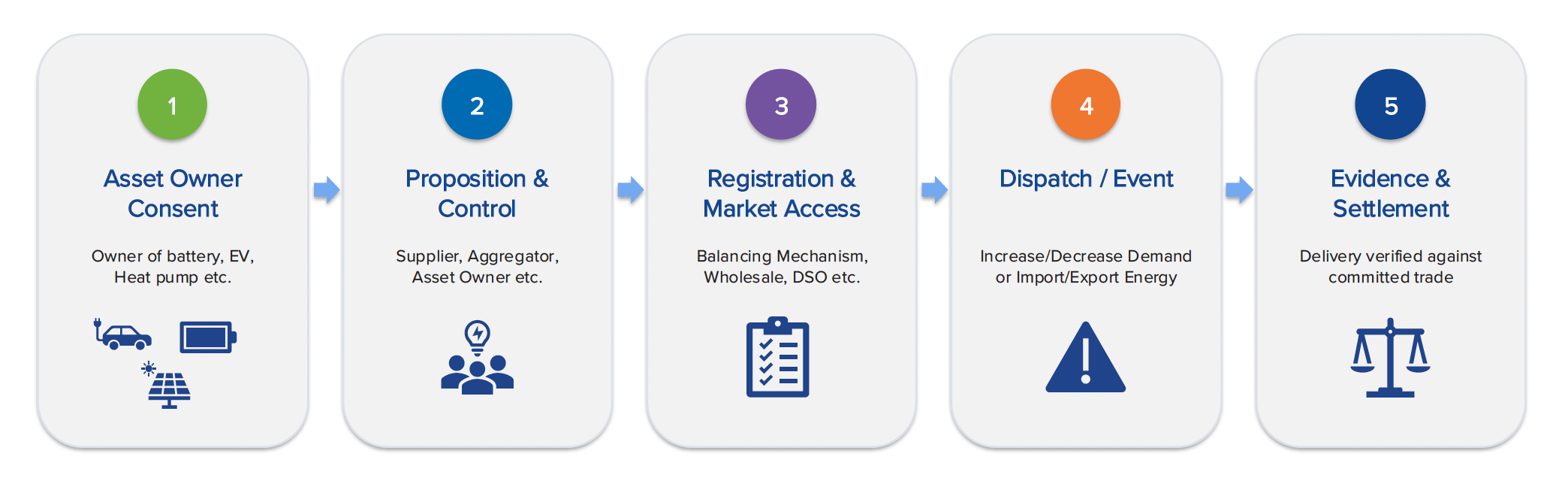
That final stage, evidence and settlement, is arguably where the biggest technical challenges lie, and it leads directly into a critical question: how is flexibility actually measured?
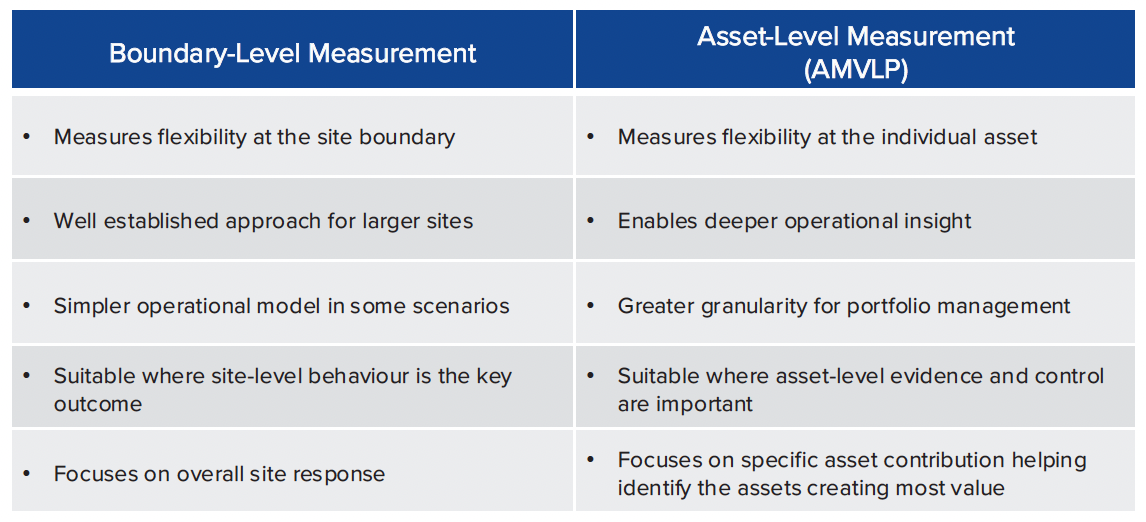
The baseline and settlement on flexible assets has typically been measured at the site boundary: the overall net change in consumption or generation at a property or site level. That approach remains well established and works well for larger industrial and commercial programmes where the site’s overall response is what matters.
But boundary-level measurement has a significant limitation: it captures everything happening at a site simultaneously, not just the flexible asset’s contribution.
A household asset might respond exactly as instructed, but changes in other household consumption or generation occurring at the same time can make it difficult to determine what the household’s consumption would have been without the flexibility event.
The same problem shows up at industrial scale: a bank of freezer units might deliver a full 200kW reduction, but if other site activity increases at the same time, the boundary meter might show only 100kW of net reduction, or none at all, directly affecting the revenue earned.
This is where “asset-level measurement” comes in.
BSC Modification P375 introduced the Asset Metering Virtual Lead Party (AMVLP) role, enabling flexibility providers to register and settle flexibility using metering at the individual asset level, behind the site boundary.
This gives much greater granularity, clearer evidence of what each asset actually delivered, and better insight for managing a portfolio of distributed assets effectively.
Metering requirements vary significantly by market, and this is often underestimated. For example:
For many organisations, the real challenge isn’t a shortage of assets. It’s knowing which ones can technically participate where, and what metering is needed to prove it.
Technology is what makes this work at scale. Market-wide half-hourly settlement is generating a “data tornado”, as previously unread sites move to half-hourly data, and this will only grow as smaller behind-the-meter assets proliferate.
Underpinning it all is a stack of interdependent layers (data, settlement, dispatch, trading strategy, market integration, and market monitoring and forecasting) which together form the technology backbone of a Virtual Power Plant (VPP): connectivity, forecasting and a clear trading strategy, increasingly supported by AI.
Across all of this, one theme is consistent: entering the flexibility market isn’t just about controlling assets well. Organisations also need to:
All while adapting to a regulatory landscape that continues to evolve. As portfolios of flexible assets grow, these operational processes only become harder to manage manually.
This gap sits between asset optimisation platforms and the market itself and it’s where genuine value is created for suppliers, aggregators and VPP operators who get it right. The opportunity in UK flexibility is real and growing quickly, but scaling participation efficiently, rather than simply proving the concept works, is now the defining challenge for the industry.
If your organisation is exploring flexibility offerings, don’t miss our practical guide for entering the flexibility market.
If you’re considering the technology necessary for flexibility offerings, discover the how Titanium Flexibility Market Interaction can support your ambitions.