News
Keeping you up to date on news, events and what’s happening at ESG…

Keeping you up to date on news, events and what’s happening at ESG…

By Carolyn Burns, Head of Industry Change & Market Engagement, ESG Global
At this year’s Smarter Energy Insights Forum, we asked the industry’s policymakers, regulators and market bodies to talk about what digitalisation will look like in practice. The morning began with a senior representative from the Department for Energy Security and Net Zero (DESNZ), who set out the thinking behind the Energy Digitalisation Framework, which was published in March 2026.
What follows are the points I think matter most for anyone in the UK Energy Industry planning ahead.
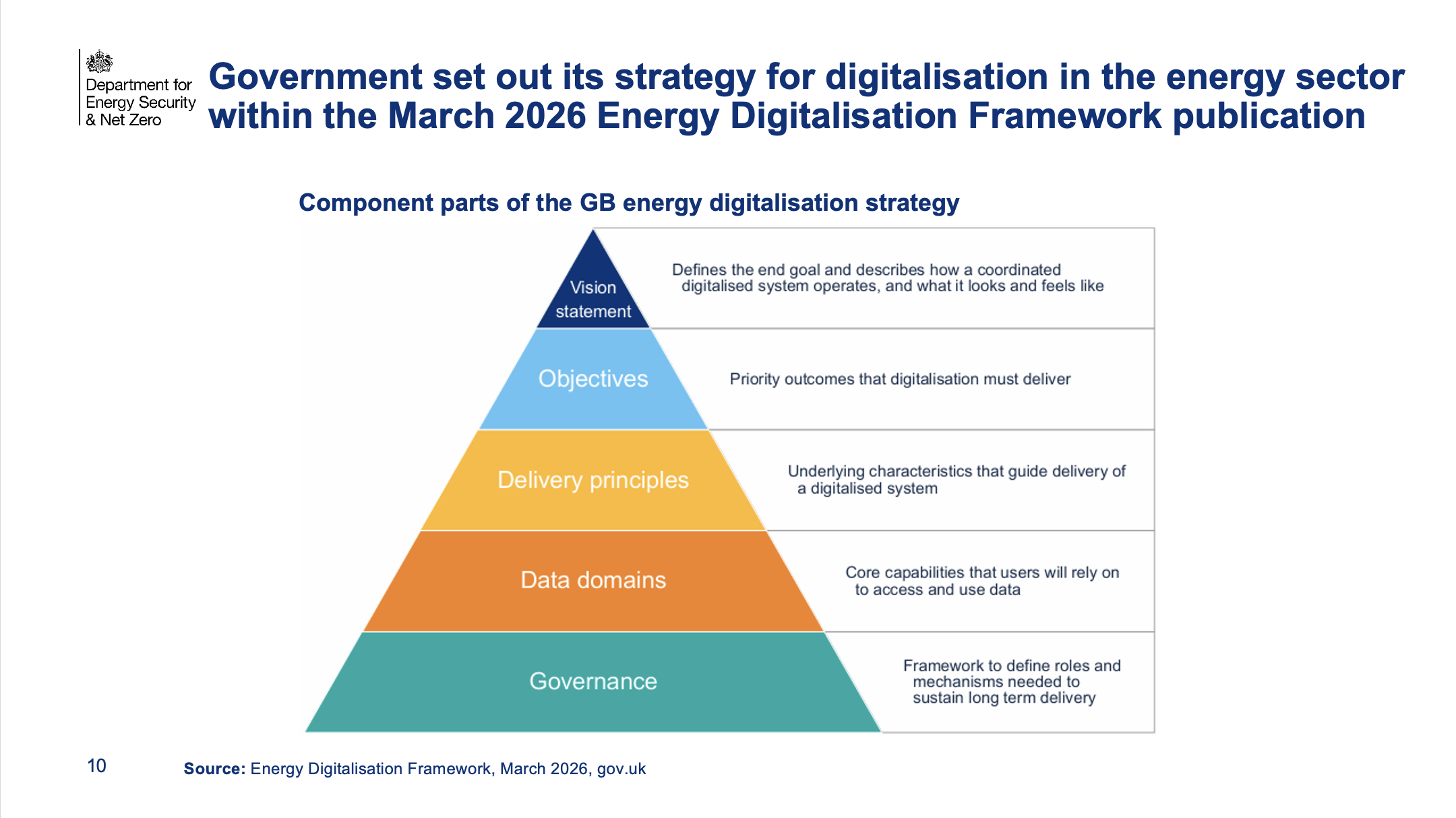
DESNZ was candid about why the Framework exists. There has been plenty of digitalisation activity across the sector over the years, but it hasn’t always been joined up. The Framework aims to change that. It sets out where we’re trying to get to, the principles we will follow, which data domains matter, and how it will all be governed.
DESNZ wants activity to happen at pace, but in a coordinated and strategically coherent way. If you’re investing in data platforms, integrations or customer propositions, it’s worth knowing that the sector is deliberately moving towards a single, shared direction of travel.
The Framework’s vision is for an energy system built on secure, interoperable and informed data sharing. Government expects that to drive more efficient system planning, real-time responsiveness and better services for consumers. Three objectives sit beneath it:
The third objective shouldn’t be overlooked. It signals that government sees data access as a route to new business models, and not only as a way of running the network more efficiently.
For retailers, suppliers and technology providers, that opens up commercial opportunities, but it also means more competition.
The Framework lists seven delivery principles, including trusted and secure, interoperable, simple and accessible, and innovative and competition driven. Duncan picked out two as particularly important: efficient and cost-effective, and deliverable.
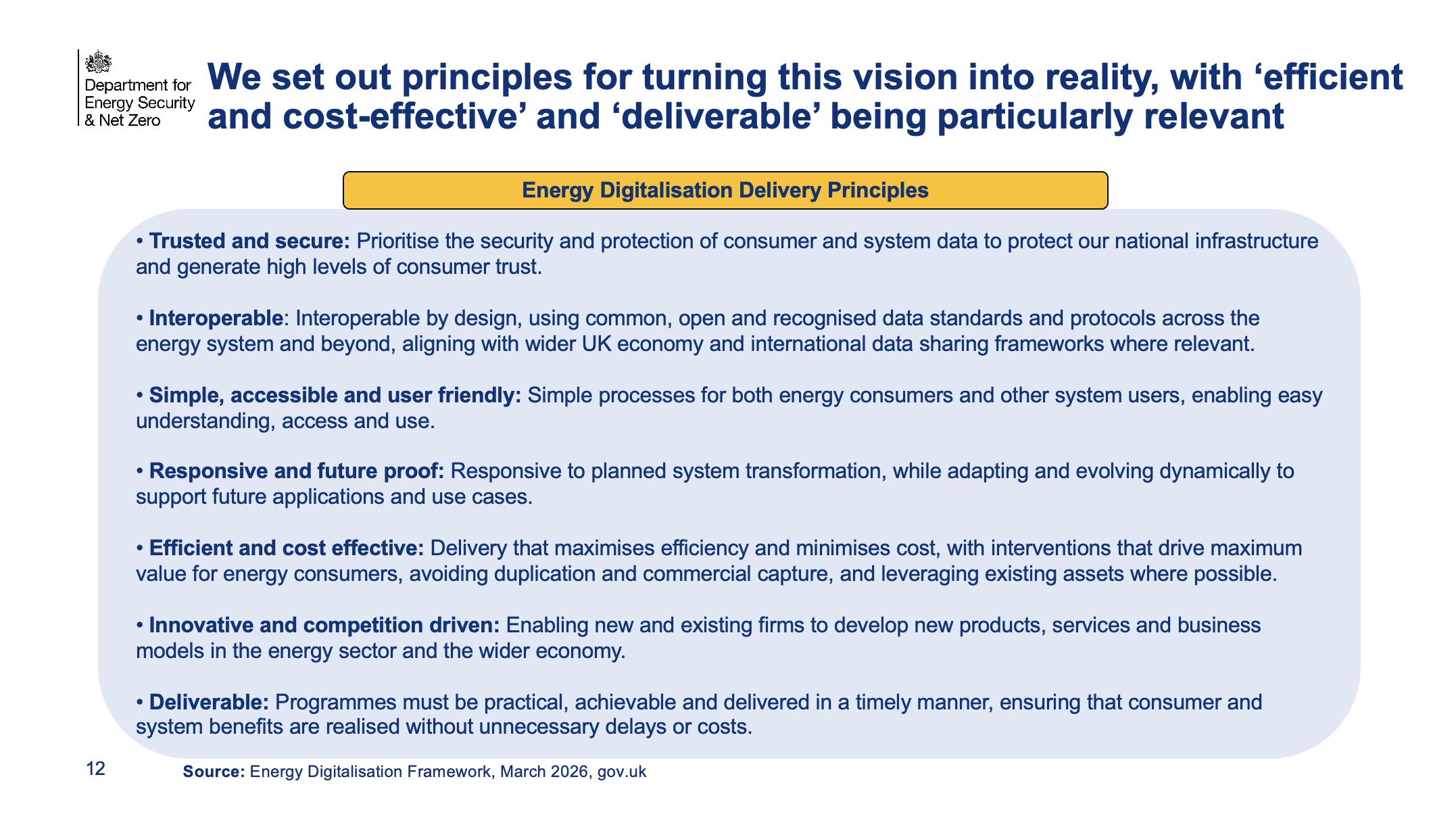
The first is about avoiding duplication. There’s a real driver for the Framework to do things in the most coherent, efficient and least duplicative way possible. That theme was picked up later in the day in a talk by a representative from the Smart Energy Code Company (SECCo).
The aim for “deduplication and reuse” drew nods around the room, and it was agreed that existing tools should be reused wherever there is no good reason to change them. But DESNz added a sensible caveat. Security and privacy standards designed for one setting may not suit another, and locking data away too tightly means the benefits are lost. Getting that balance right will be a continuing challenge.
The second principle is deliverability. Programmes need to be practical, achievable and ultimately usable by consumers, who have less tolerance than anyone for complex products.
We returned to this theme in the Q&A, reflecting that the industry may historically have asked consumers to make too many choices about things that they shouldn’t have to think about. That’s a useful lesson for anyone designing customer journeys or consent experiences.
The Framework identifies four key data domains: core energy system, behind-the-meter assets, consumer, and metering data. It also sets out the infrastructure needed to move that data securely between the right parties, including the Data Sharing Infrastructure and the Consumer Consent Solution. Each domain has a coordinator: National Energy System Operator (NESO), the Retail Energy Code Company (RECCo) and Elexon between them.
“Coordination” was definitely the focus. The aim is to bring the right expertise into one place and do things once, with one set of rules on data quality or interoperability, rather than several competing ones within a domain.
This point is practical for anyone who holds or uses energy data. The domain coordinators are shaping the standards and language that will govern data sharing. As a representative from NESO put it, the domain coordinators want to hear from the wider industry, and she encouraged attendees to speak to them.
NESO also made a point that should be relevant to anyone looking at their data practices. The challenge in core energy data is often about context and shared language more than technology, and NESO is looking closely at metadata as a way of building that common understanding before it digs into technical standards.
The governance arrangements are more complex, but there were three main elements that were emphasised.
This provides overarching oversight, ensures the domains develop in line with strategic direction, and acts as a change-control function to stop unexpected developments that don’t mesh with everything else.
This brings the domain coordinators and other relevant parties together in the interim, supported by various sub-groups.
Government has committed to consulting later this year on an enduring body that would look across all domains “as a single pair of eyes”. The options for what it looks like are still open.
A speaker from Ofgem was honest about the trade-offs here. Consultation is time-consuming, and the regulator gets complaints when it consults and when it doesn’t. It’s also clear that governance has a cost, and care must be taken not to create unnecessary layers. If you have views on how a future coordinator should work, the consultation is your chance to shape it.
The Regulatory Roadmap session that followed DESNZ gave a useful sense of the pace. A few dates are worth noting:
We’re past the conceptual phase. And NESO representatives added that the Data Sharing Infrastructure is designed as an organisation-to-organisation solution and is not a consumer-facing app. It is a connective layer that lets data flow securely between participants without storing it centrally.
The DESNZ presentation finished by explaining how The Data (Use and Access) Act 2025 introduced powers for smart data schemes, modelled on open banking in the financial sector. Government published a Smart Data Strategy in March 2026, estimating around £9.5 billion of net social value by 2043 from applying these powers in the energy sector.
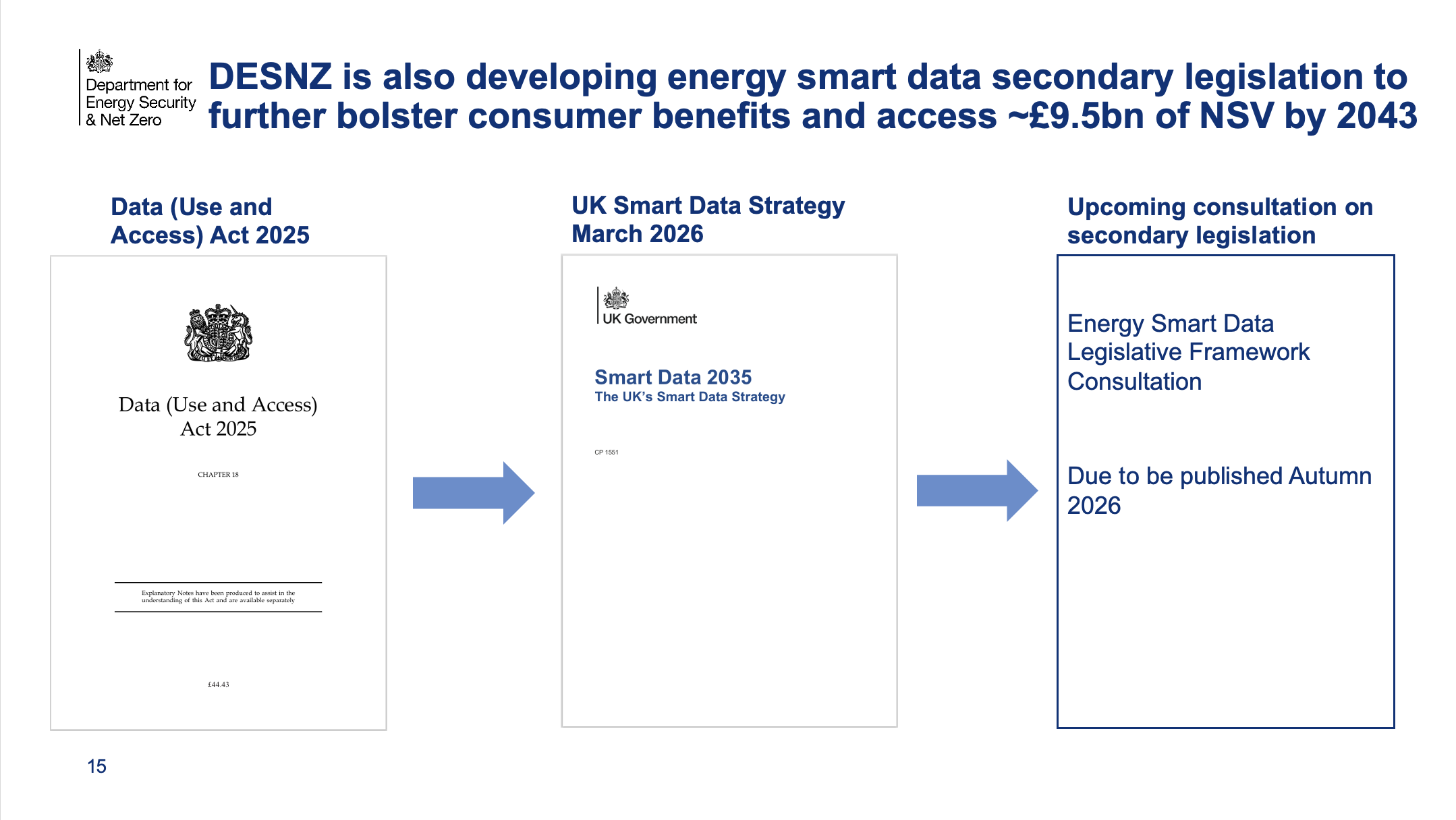
A consultation on the secondary legislation is due this autumn, with the Smart Data Legislative Framework having been published in mid-October. It was stressed that government will build on existing rules and won’t duplicate them. The legislation is about filling gaps and using legal powers only where they are needed.
The key change is that existing data holders would be required to share the data they already hold on consumers with third parties when the consumer consents. The aim is to let new offerings reach consumers smoothly and without friction.
If your organisation holds consumer data, or wants to use it to develop propositions, this could change your obligations and your opportunities. It’s well worth preparing a response now.
The Q&A session was lively, and one theme dominated: trust. Consumers need to understand the benefit of sharing their data and to feel in control. A RECCo representative noted that research shows consumers are much happier to share data once they see the value, provided they control the sharing.
Ofgem explained that the plan is to build consent from the ground up with consumer advocacy groups, like The Citizens Advice Bureau and price comparison sites, the organisations consumers already trust, rather than relying on the regulator to promote it.
That has implications for how we all communicate. Explaining data in non-data terms is an art, and it may be the difference between consent that is given willingly and consent that’s withheld through fear or lack of understanding.
The Framework sets the direction, and the delivery milestones are coming quickly. Whether you are shaping retail strategy, technology architecture, customer engagement or regulatory response, my advice is to engage early. The panellists said repeatedly that their doors are open.
Consultations on the digital architecture, the coordination function and the Smart Data Legislative Framework all fall within the next few months, and the people writing the rules are asking for input.
At ESG, we will keep following these developments and sharing what we learn. If you would like to talk through what the Framework could mean for your organisation, please get in touch on LinkedIn. I’d be glad to hear your thoughts.
Image sources: “Energy Digitalisation Framework: The Government Strategy” presentation given by DESNZ at Smarter Energy Insights Forum 2026.