News
Keeping you up to date on news, events and what’s happening at ESG…

Keeping you up to date on news, events and what’s happening at ESG…
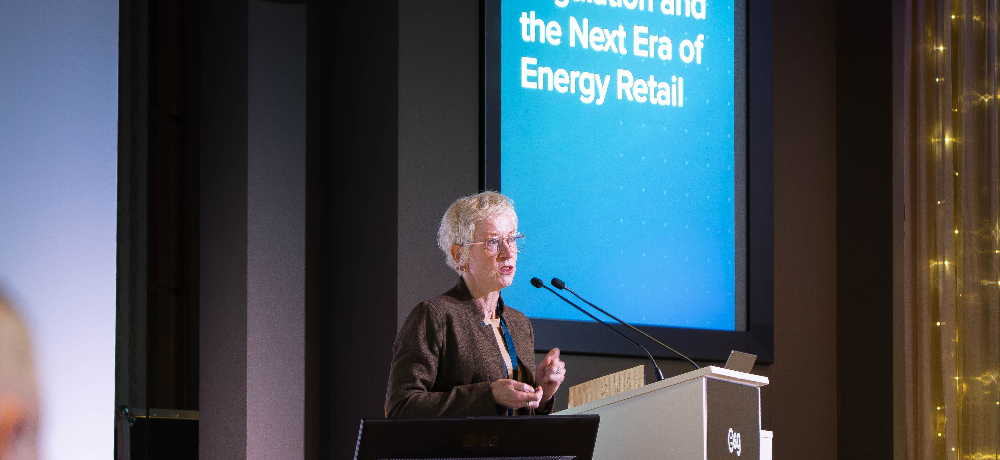
By Carolyn Burns, Head of Industry Change & Market Engagement, ESG Global
Most conversations about energy digitalisation focus on what is new: new platforms, new standards, new coordinators. At the Smarter Energy Insights Forum, Ros Singleton, Director for Technical and Business Architecture for the Smart Energy Code Company (SECCo), made a strong case for looking at what already exists.
This was more than a company introduction. It was a challenge to the sector to use the smart metering infrastructure that consumers have already paid for, and to be careful not to build things twice.
SECCo was upfront that many people in the room would not be familiar with their company, because it has not historically been very vocal. SECCo sits at the junction between government, regulators and industry, and helps to align policy, rules and delivery. Everything the Smart Energy Code (SEC) does is ultimately focused on benefitting the energy industry and its customers.
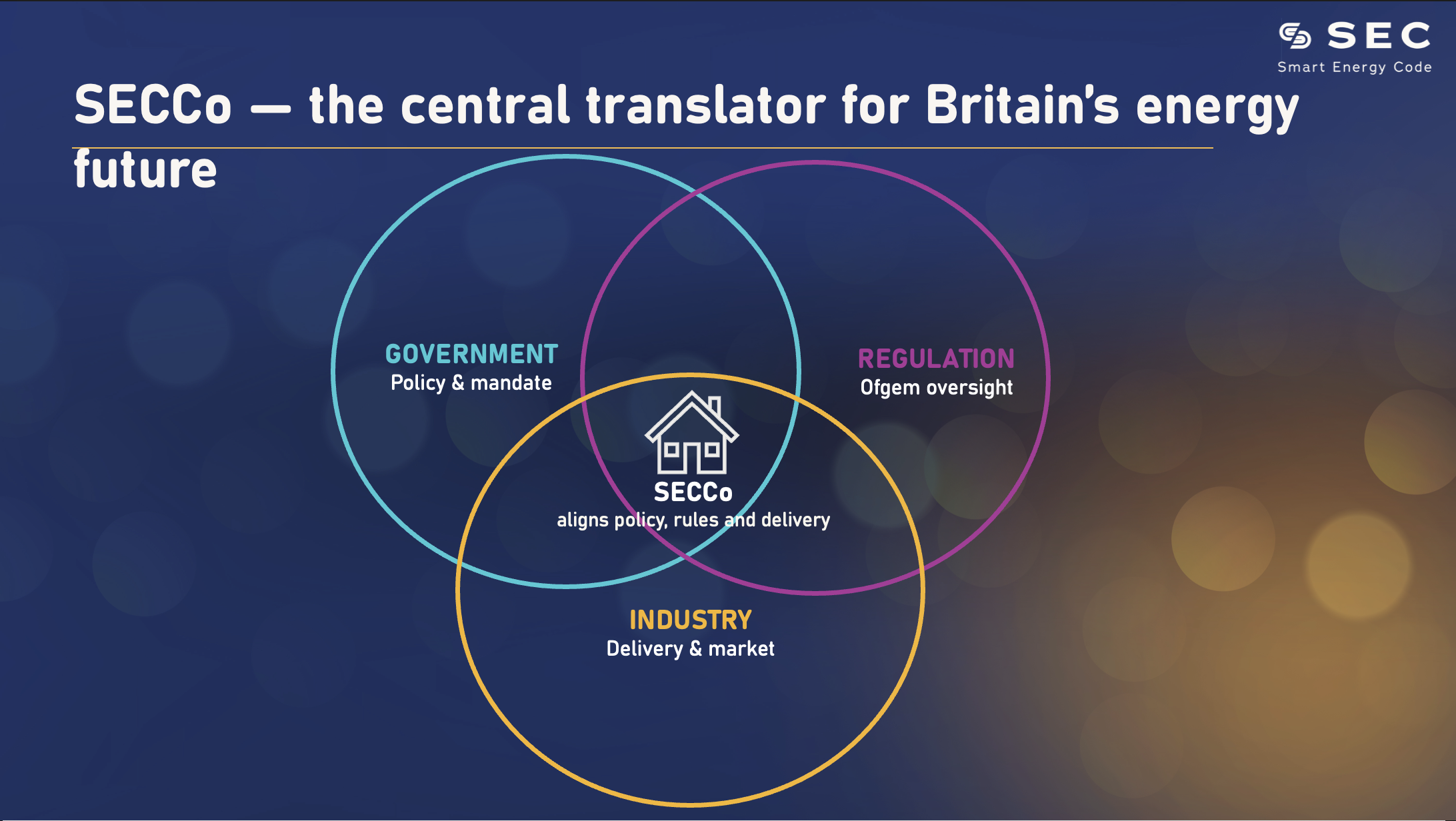
The SEC defines how smart metering works across the UK. The Data Communications Company (DCC) runs the network and looks after the billions of data points that pass across it each year, and SECCo works with the DCC and SEC Parties (gas and electricity Suppliers, Distribution companies and Other Users) to help it evolve. Ros’ own role is to lead on technology and architecture.
Recent history explains why SECCo now wants to publicly engage. The SEC was established around 2013 to govern the smart metering arrangements. In 2023, a new chair was appointed, who instigated a review of how the SEC operates.
The panel approved a new operating model, an executive team was established, significant contract savings were achieved and recruitment followed. The team is small, at around 24 or 25 people, but is punching above its weight – focusing on consumers and value for money.
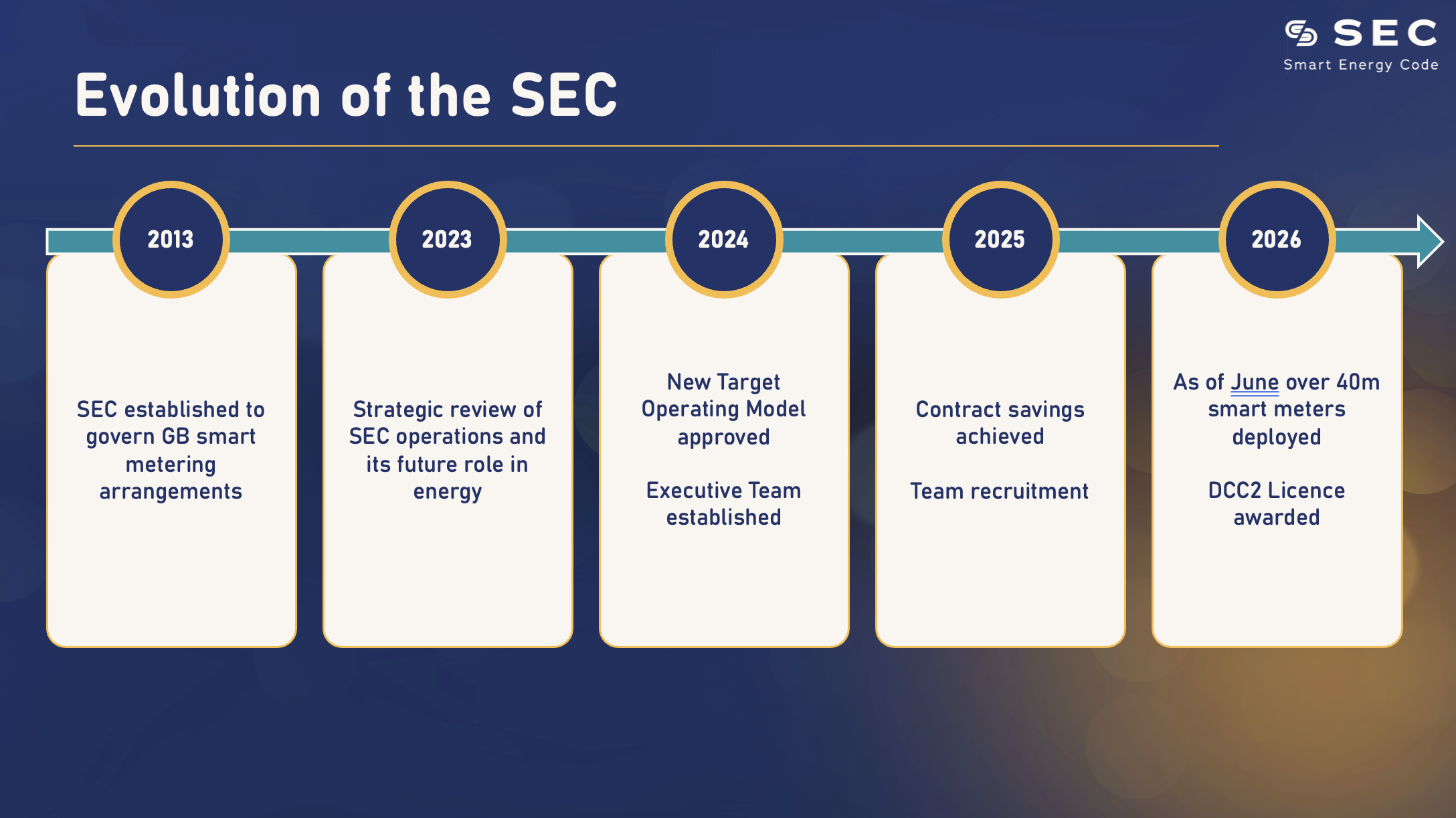
Two milestones from 2026 stand out:
The implication for the industry is that the organisation responsible for the smart metering rules will be the parent company of DCC, which runs the network that carries the data. Anyone who relies on smart metering data for billing, settlement or propositions will want to understand what that transition means for them.
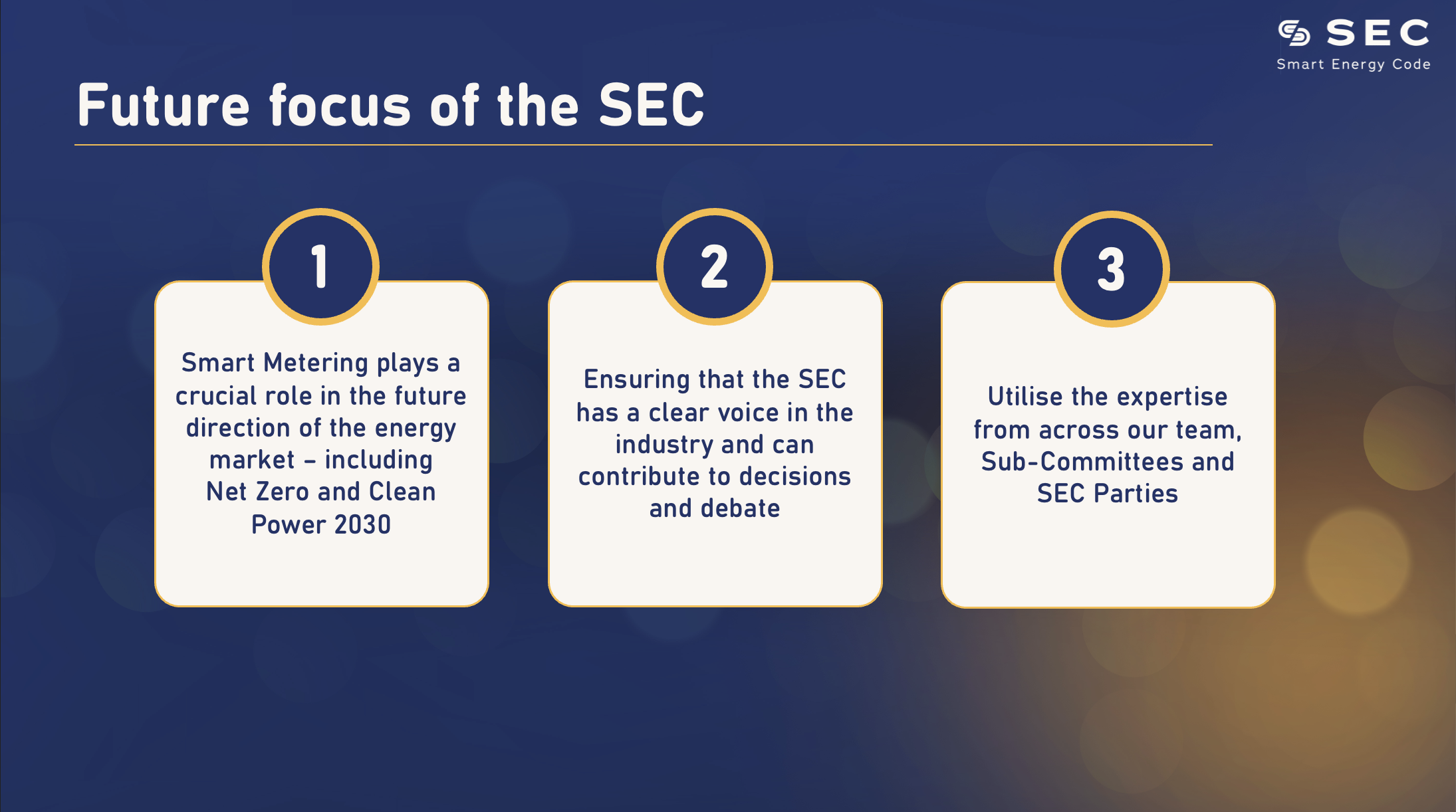
SECCo wants to be more visible and accessible. They’re open to feedback through the SECCo Board members, particularly regarding their three-part future focus:
The practical takeaway is that the SEC change process is a route for influence, and one that many organisations underuse.
The heart of the talk was about data. SECCo’s aims are to reduce duplication, reuse existing code tools and drive collaboration. Ros’ argument was straightforward. Her background is in building software and networks, and in any industry there is a recurring problem of the same thing being built in many places.
In energy, with regulators, codes and other mechanisms all involved, each duplicated effort means consumers pay twice.
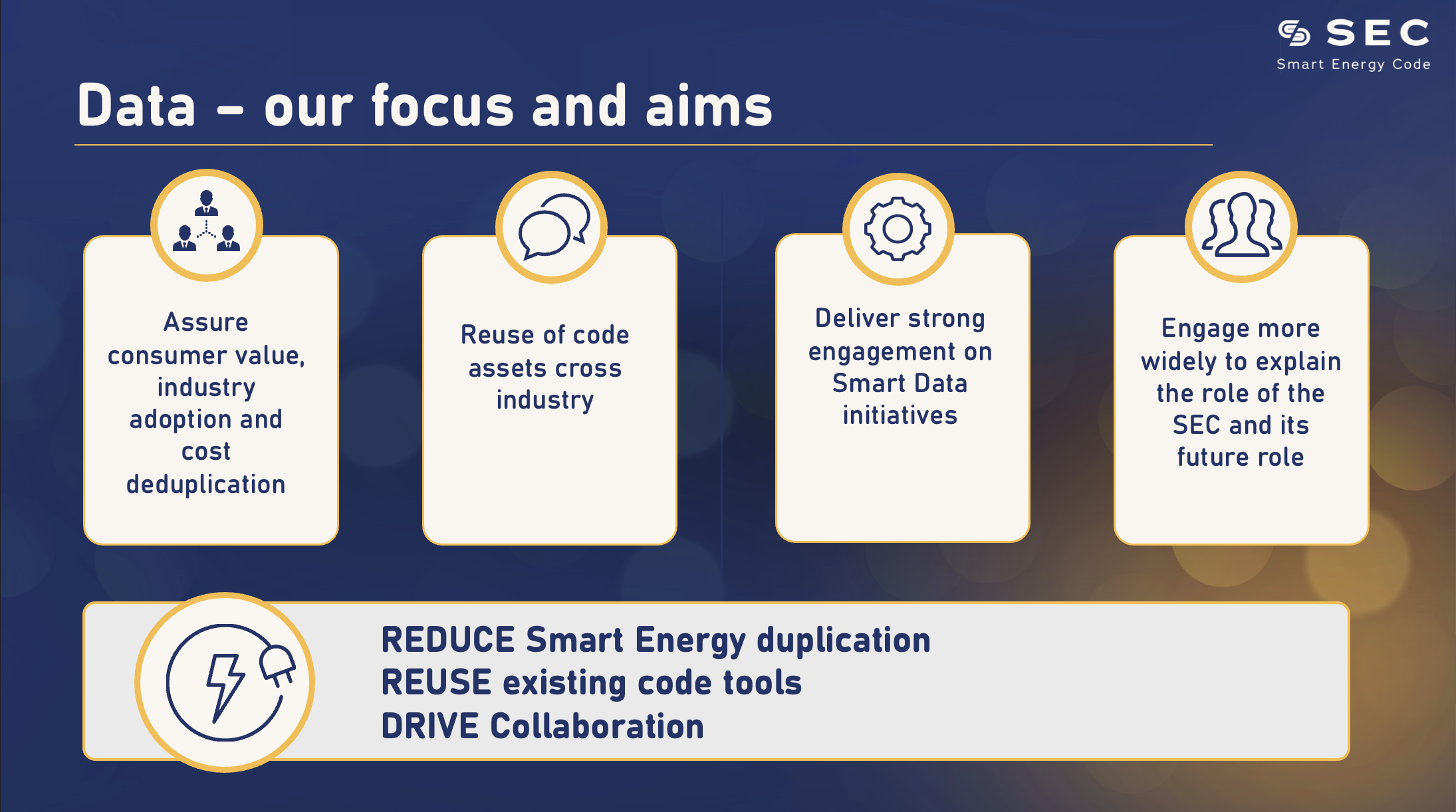
There were two ideas that stuck with me:
The talk explained that if you could break codes down into their component rules, participants could pick up the pieces they need. If an organisation has already demonstrated its security credentials or has consumer consent in place, others could rely on that instead of asking it to prove it again.
This was linked to the wider challenge of knowing who belongs to what and who is approved to do what across the industry. This connects directly to the trust framework discussions that NESO described in the DSI session.
Ideas like microservices and object orientation have been around for decades, but the principle of building things once and reusing them still holds. The SEC’s mature mechanisms were highlighted as an example. There’s a nationwide network that was designed in 2013 and has been battle-tested, and while it might not have been perfect, the talk stated it now works and is mature.
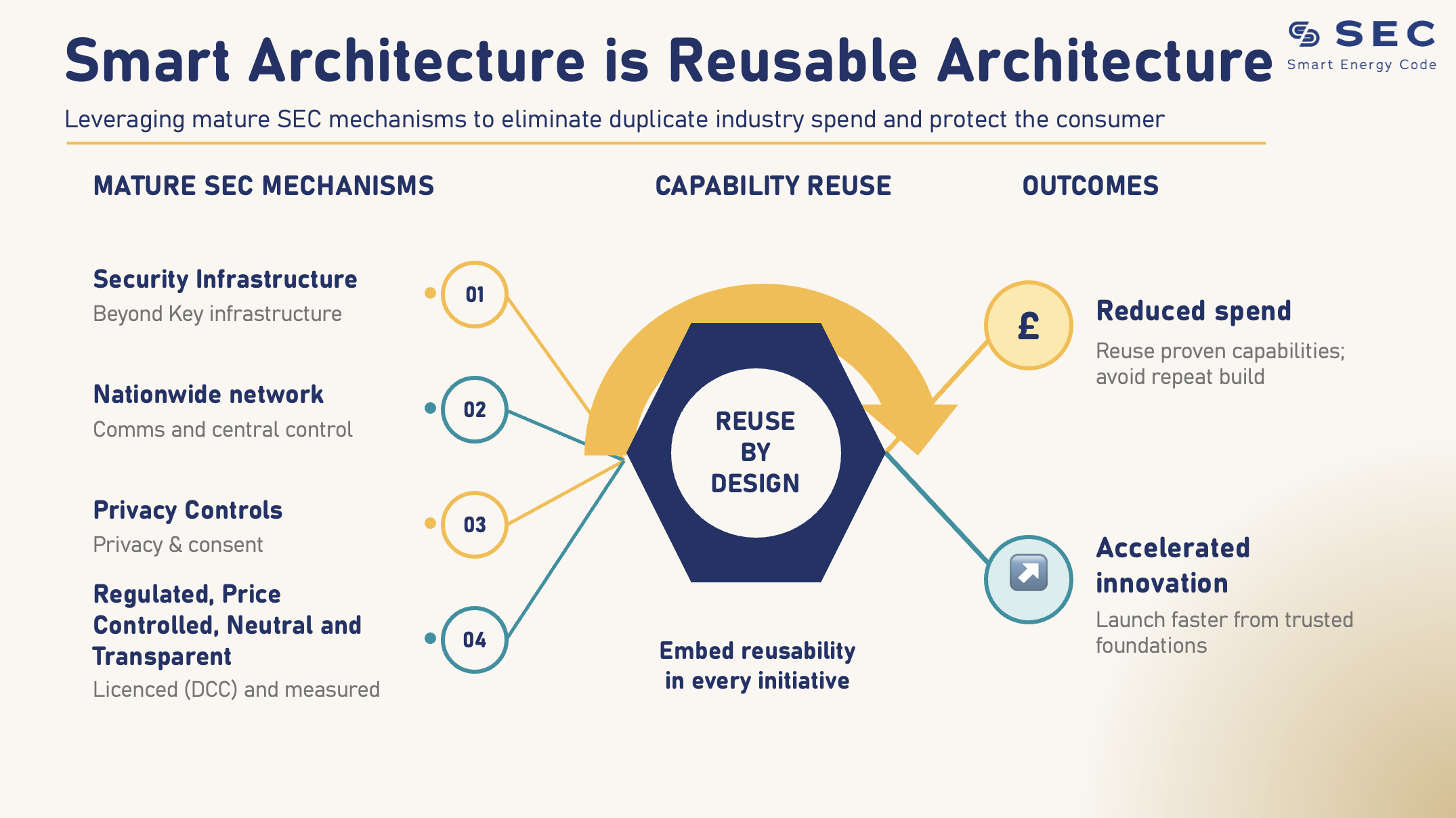
There are four elements from the SEC that could be reused:
The outcomes SECCo wants are reduced spend and accelerated innovation, with new entrants launching faster from trusted foundations.
SECCo and the DCC are neutral and focused on transparency and delivering value for money, and aren’t focused on profit, which puts them in a good position to provide tools that others can use.
It was useful to hear how the talk fitted with what other speakers had discussed.
SECCo is working closely with RECCo on the Consumer Consent Solution, and has started working with Elexon to assist them as the metering data domain takes shape. A Elexon representative later described the established data-sharing flows in metering, so there’s plenty to draw on.
SECCo could help with the challenge of negotiating data-sharing contracts digitally. It is easy once you have worked out how, but getting there is tricky. An Ofgem representative stated they want to explore how the SEC’s experience could help with the data trust framework.
A senior DESNZ representative welcomed the reuse principle, with a sensible caution. Security and privacy standards designed for one setting may not be right for another, so the reuse should be conscious and not automatic. If there’s no good reason to change something that exists, use it. The sector also needs to avoid locking data away so tightly that the benefits are lost.
The Q&A moved from architecture to a question that has been debated in the industry for years: should smart meters and half-hourly data be mandated?
It was acknowledged that industry has lobbied for a mandate, arguing that it would stop money being spent on persuading consumers and let everyone concentrate on delivering benefits.
But it was equally clear that consumer choice matters, and that the sector has a lot to do to earn trust. Whatever the industry builds, it must demonstrate that it’s secure, and consumers must retain the ability to opt in or out. The consumer consent work will be crucial.
There are really two questions: how voluntary it should be to have a smart meter, and whether the data is shared for settlement. With regard to the second, the representative from DESNZ’s view is that market-wide half-hourly settlement should use real data as far as possible, rather than continuing with dummy profiles, which is essential to delivering the benefits of that programme.
Other teams at Ofgem are working on benefits reservation, and that a smooth opt-out process is his priority. For suppliers, the message is that the quality of communications with customers is likely to remain a focus.
Ros’ message was a simple one, and it is repeated in her closing lines: deduplicate and reuse. There are a few practical implications.
At ESG, we will continue to follow how smart metering and the wider data agenda come together. If you would like to talk about what this means for your organisation, please get in touch via LinkedIn.
Image sources: “Energy Digitalisation Framework: The Role of Smart Metering” presentation given by SECCo at Smarter Energy Insights Forum 2026.