News
Keeping you up to date on news, events and what’s happening at ESG…

Keeping you up to date on news, events and what’s happening at ESG…
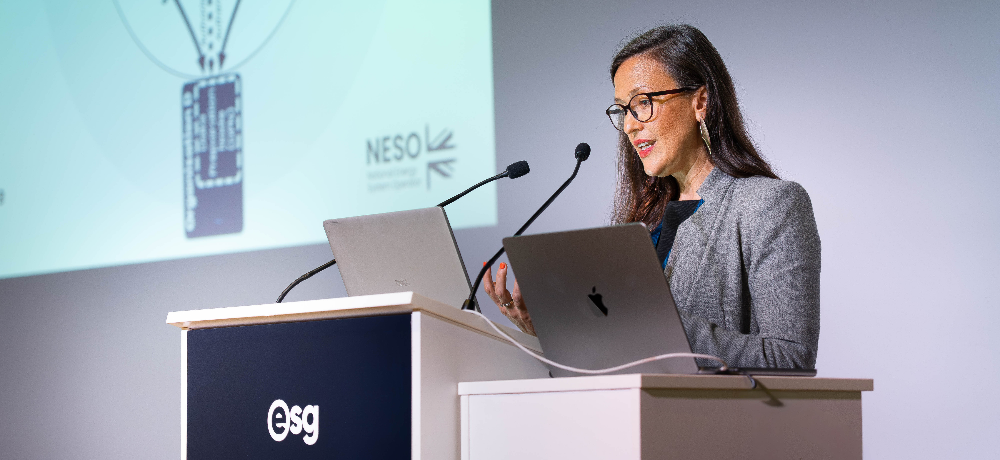
By Carolyn Burns, Head of Industry Change & Market Engagement, ESG Global
Most of the talk at the Smarter Energy Insights Forum about digitalisation strategy was, understandably, about policy and regulation. The session from NESO’s representatives did something different. It showed what’s actually being built, who is using it, and how the sector will need to change to get the value from it.
They described two connected pieces of work: the Data Sharing Infrastructure (DSI), and NESO’s role as coordinator of the core energy system data domain. Here are the points I think are most useful for anyone planning how their organisation will share and use data in the coming years.
The session began by placing the DSI in the context of NESO’s wider remit. Since it was formed in 2024 as an independent public body, NESO has licence condition to facilitate coordinated digitalisation of the energy system as well as operating and planning the physical one. Four strands of work were outlined:
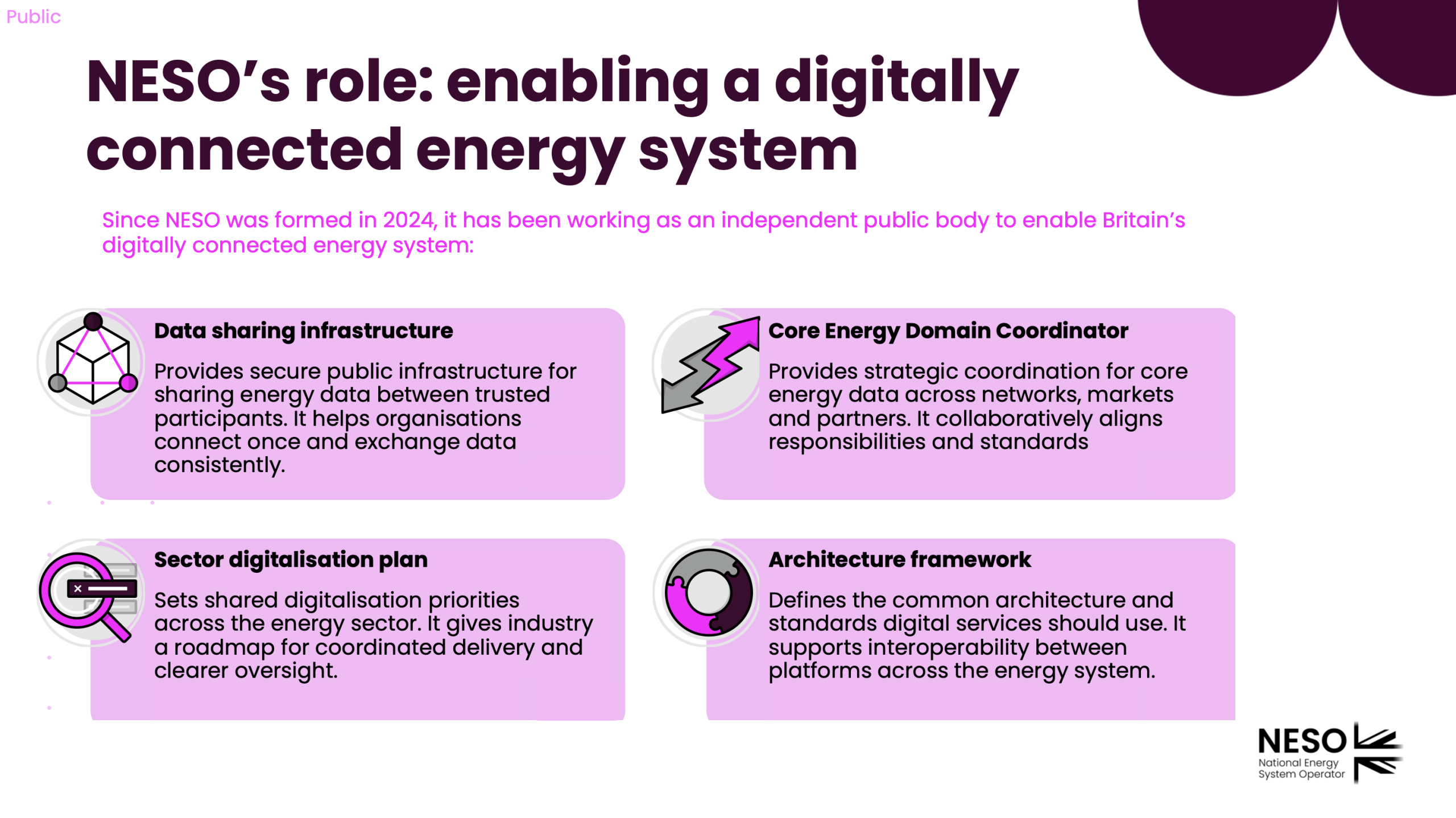
The architectural reference framework was developed jointly with Elexon and RECCo, and Sasha was clear that it is version one of many. The stated reason for the partnership is to avoid the cost and risk of ripping things out or forcing convergence later. It is an approach I would like to see more widely across the industry.
The DSI was described as a data highway for the energy sector, and “connective tissue” between participants. It’s deliberately not a replacement for existing real-time data exchanges. Platforms built for specific flows and use cases remain, and the DSI is meant to help organisations connect securely.
The problem it addresses will be familiar to many. Data sharing today is often a matter of bespoke, one-off connections, a tapestry of legal agreements and back-and-forth emails just to get access.
Once you have the data, it may not be in a useful format. The aim is to turn this into structured, consistent and predictable data products.
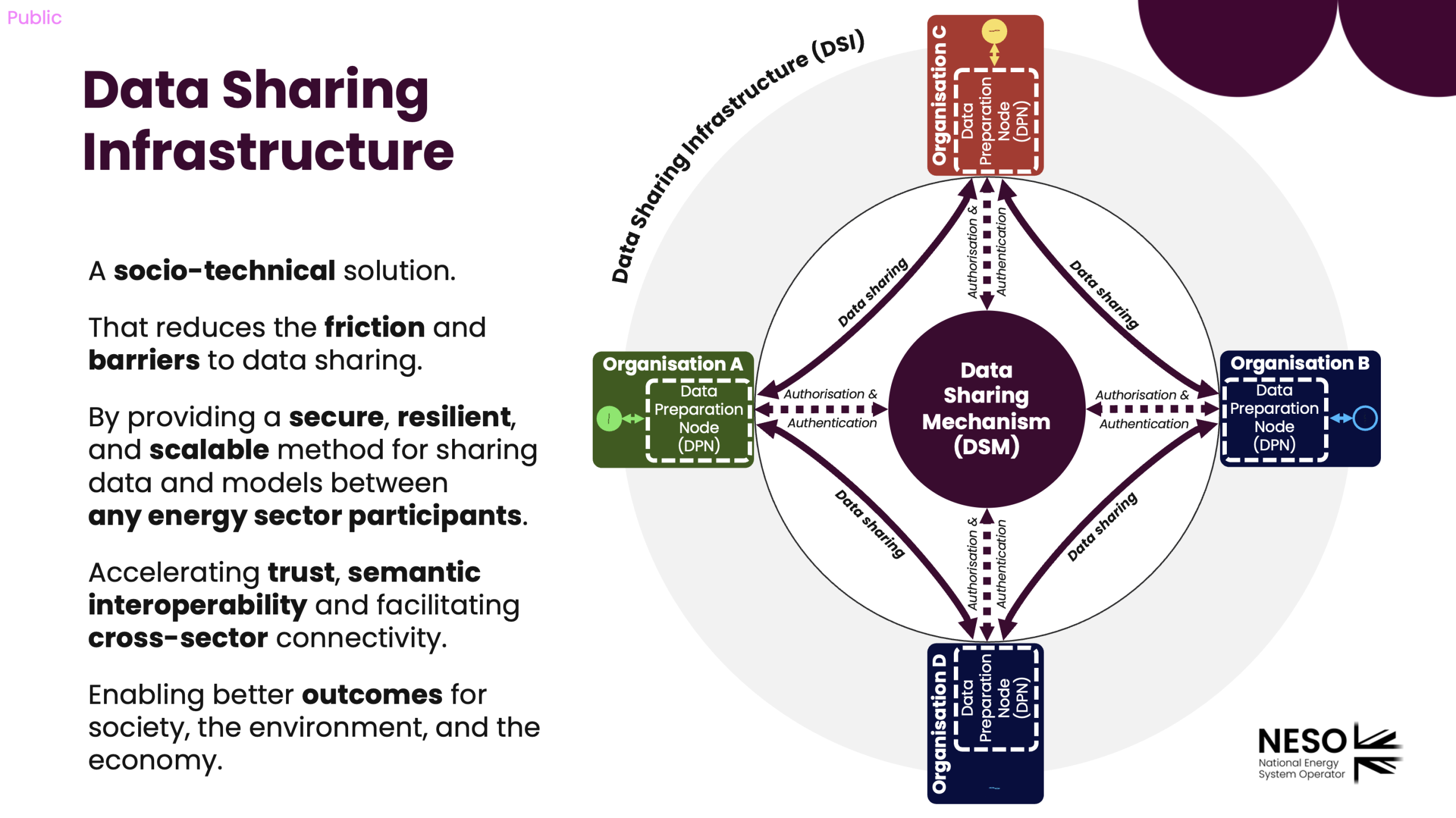
The mechanics are worth understanding:
1. Each participant deploys a node at its organisational boundary. Sasha described a spectrum from a full reference-architecture node supplied by NESO to a lighter REST API connection.
2. Everyone signs up to a trust framework, a set of legal agreements that sets the rules of participation and protects participants. It acts as both sword and shield, and it means everyone plays by the same rules.
3. The data sharing mechanism in the middle controls the flow through authorisation and authentication, but never stores the data.
The last point matters for data owners. Participants set their own rules about who can access what, and the mechanism enforces them. The technology was described as a thin layer, and the tech isn’t really the challenge. Getting organisations to agree how they want to share is the harder part.
A pilot concluded in summer 2025, focused on outage planning with around seven participants. It proved that the approach can scale and confirmed the urgent need for it. That led to government and Ofgem giving NESO a mandate as interim DSI coordinator, and the work is now a permanent capability rather than an innovation project.
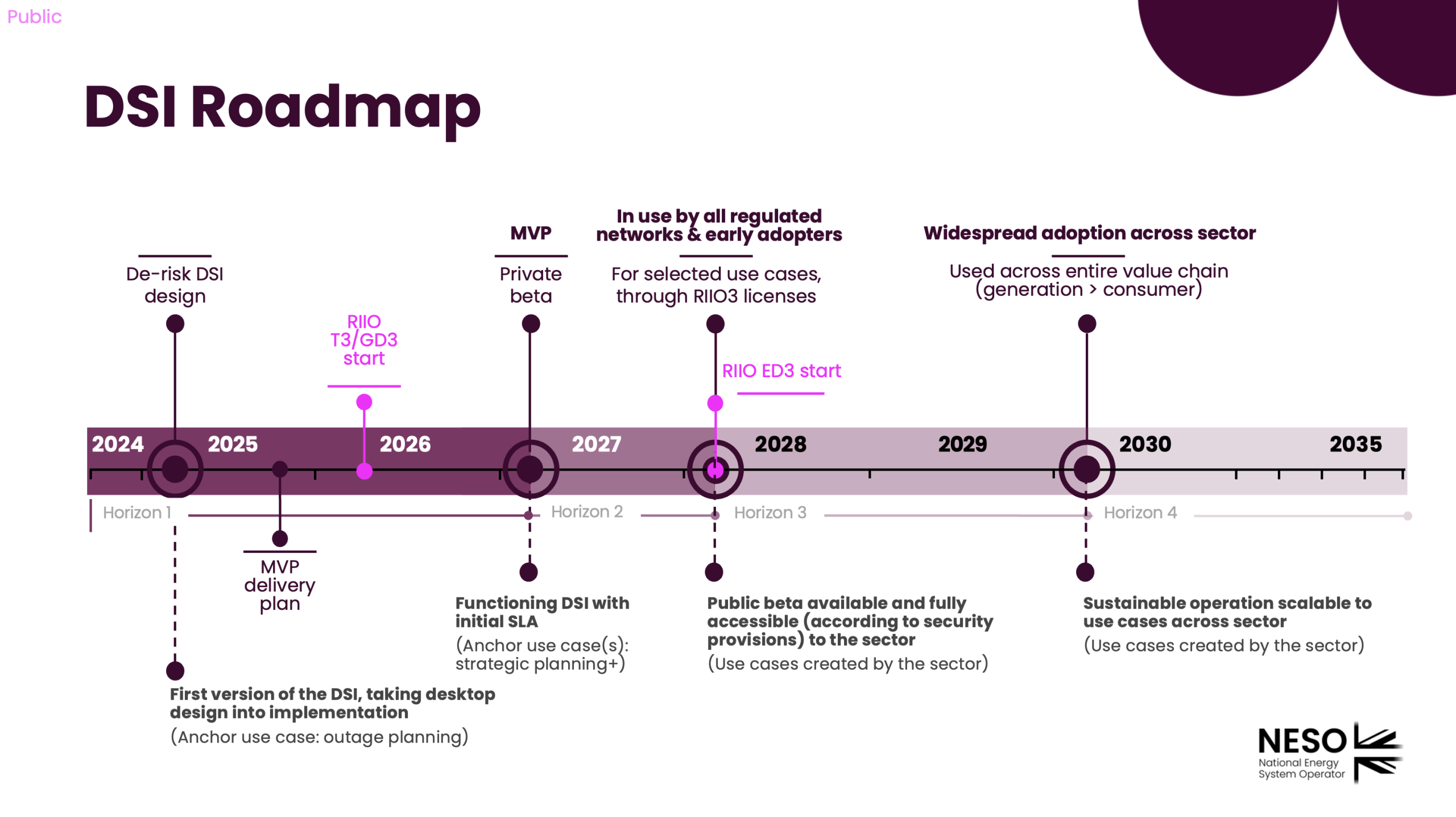
The current milestones are as follows:
Now: the MVP baseline build is complete, with further releases due before testing begins. There are 15 participating organisations, including all the regulated networks (electricity and gas, transmission and distribution), Ofgem and NESO.
NESO participates in the DSI and also coordinates it, but these are two very different teams, in different parts of the organisation, with different funding and profiles.
The first use cases were chosen to be benign and predictable, so that participants can get comfortable. Here are the anchor cases that were laid out:
This involves gathering thousands of datasets, from geospatial to network to asset data, at a granular regional level. Removing the friction here will make many people’s lives easier.
Gas transmission and distribution networks submit performance data to Ofgem each year, some of it sensitive. Both sides will hold a node, replacing the current situation where each network does it slightly differently.
This is regional planning specifically for Wales, aimed at improving the uptake of renewables on the Welsh grid.
Beyond that, next year the priority is to onboard the Flexibility Market Asset Register (FMAR), so that it can be discovered through the DSI like any other data product. This is the “put it out once and use it many times” idea.
There’s also work being done with small and medium-sized enterprises, innovators and academia, including a project exploring links to the water sector. The DSI’s catalogue will let organisations make their open data discoverable in one place.
DSI is intended to be agnostic. The coordinator won’t dictate which use cases are allowed. One data product can unlock many uses, and a geospatial dataset might support planning, connections, outage planning and strategic planning all at once.
What matters is that participants follow the same rules: “let the data flow, good things will happen.”
The links with other initiatives are also becoming clearer. An Elexon representative noted that data sharing through the Data Integration Platform is being planned for the DSI. The Smart Energy Code Company also separately stated they will help with the tricky business of negotiating data contracts digitally, which is exactly the kind of reuse the sector will need.
The conversation then turned from infrastructure to the data that will flow through it. The DSI is new, shiny and designed for the future. The data it will carry isn’t. It has a history and luggage.
Even within NESO, the control room’s real-time operational data, the teams working on assets and resilience, and the teams doing forecasting and planning can find themselves having the same conversation in three different languages.
If that’s true within one organisation, imagine the sector as a whole. What’s missing is a layer on top that lets us talk about energy without immediately splitting into electricity and gas.
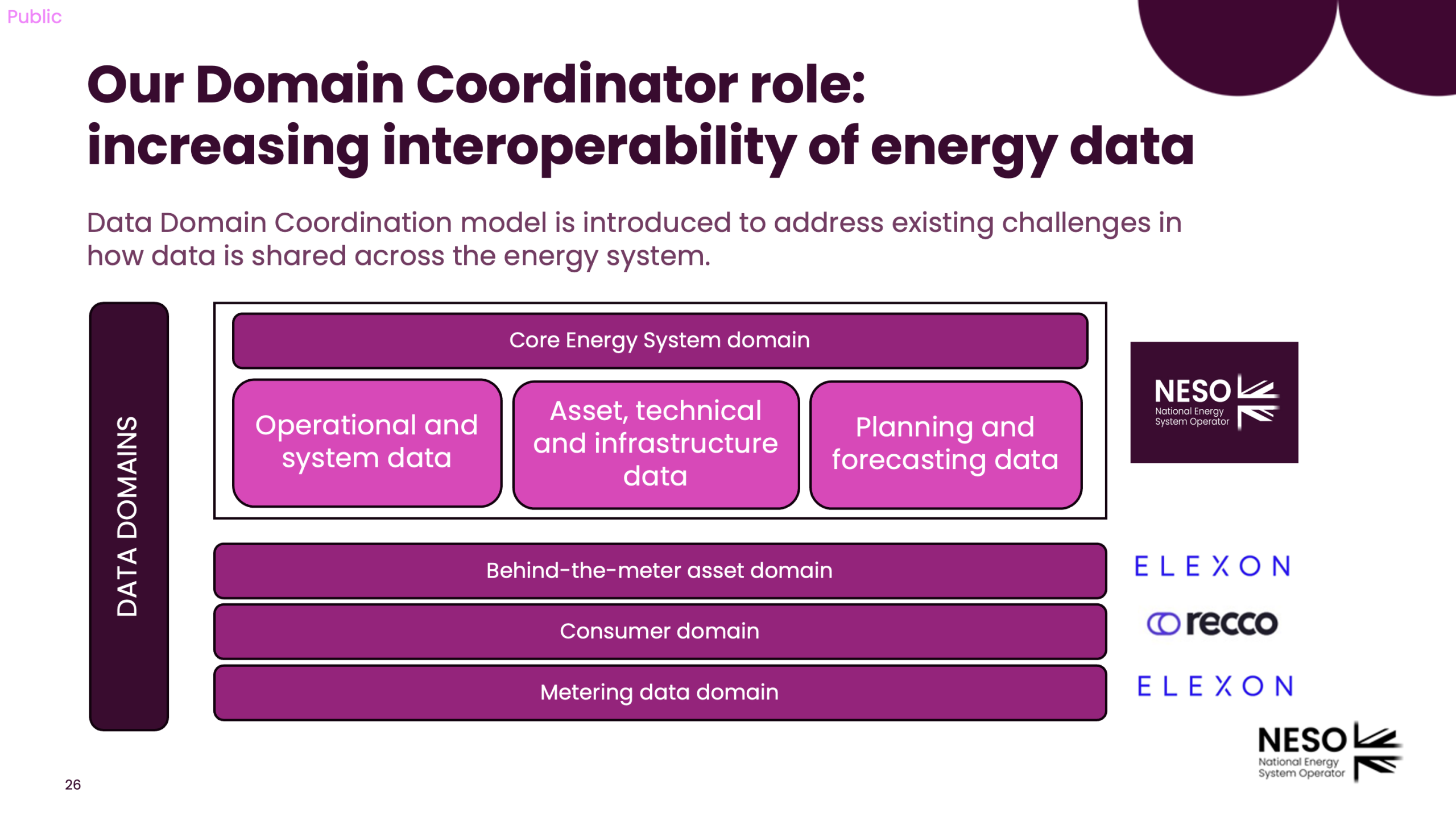
The core energy system domain covers operational and system data, asset, technical and infrastructure data, and planning and forecasting data. The coordinator’s first priorities are deliberately foundational:
It might sound odd to spend time defining what “core energy system data” means, but it matters. There’s a lot of reference and cross-domain data, so coordinators need to agree where the boundaries lie and which reference points everyone can rely on.
The work starts with a list of existing standards and the gaps between them. There’s no single standard that works for everything, and boundaries such as “this is for gas, not applicable here” become visible as soon as you start looking.
NESO is mapping stakeholders (data holders, data users and system participants) to decide what engagement structures are needed.
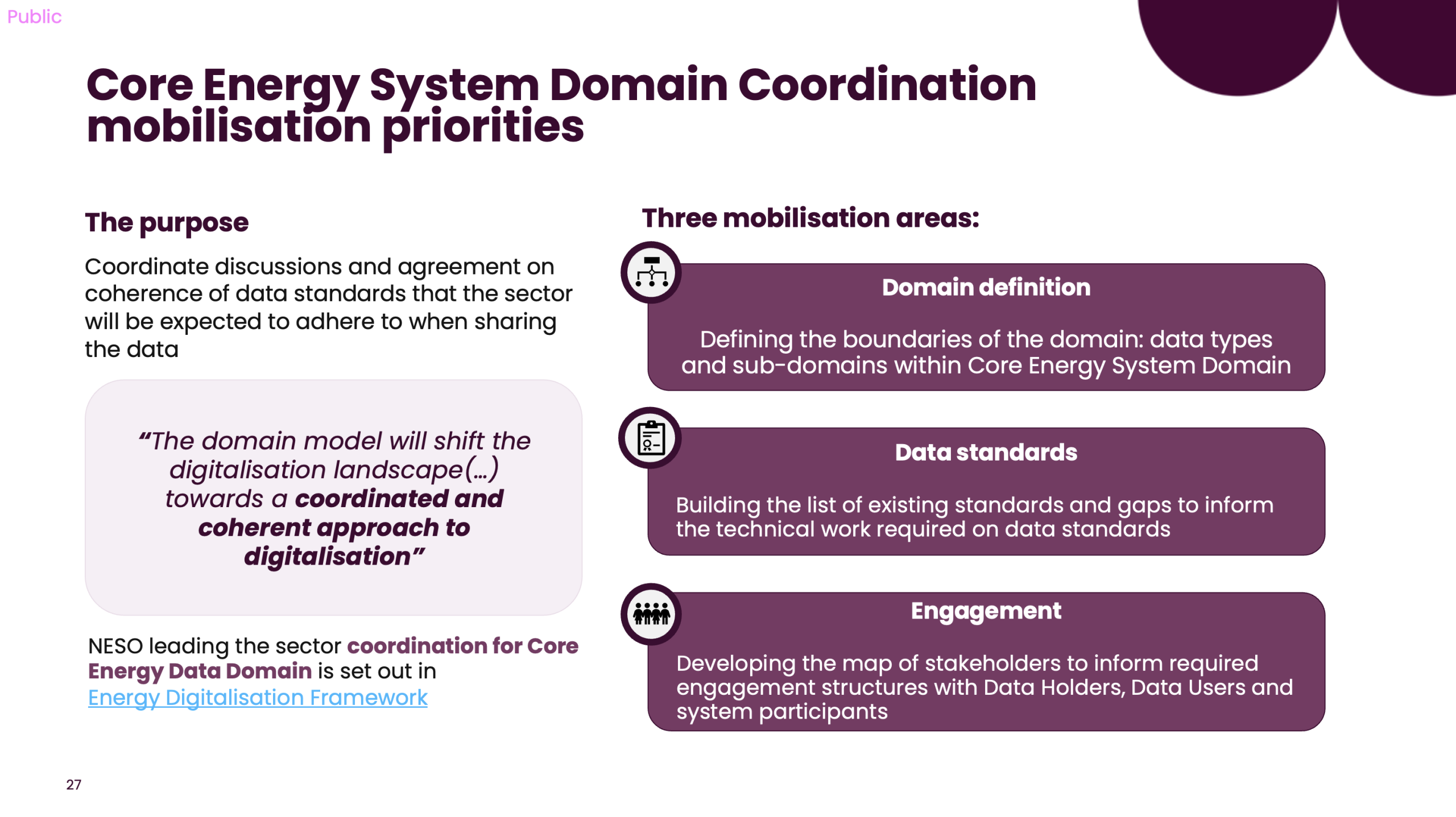
NESO isn’t starting with technical standards. It wants to build context and shared language first, so that existing technical standards can then be applied, data quality can be observed and improvements can follow. It’s a sensible approach for a sector that has plenty of standards but not always a common vocabulary.
As the DSI opens up and data begins to flow, what goes first? Should the priority be to invite people to share and expose data, or to look at standards? How do we make sure we enrich the infrastructure with data that makes sense to others and not only to us?
There’s also a gap that isn’t technical at all. In response to a question about the biggest data gap affecting consumers, the response it was context, and the fact that we have never really explained to consumers what they gain by sharing their data. About half of the future use cases are ones we can’t yet imagine.
That’s the case for building the capability and letting innovators find the applications, but it also means the industry needs better ways of explaining it in non-data terms.
The practical implications for the industry are these.
At ESG, we will continue to follow how the DSI and the domain coordination work develop. If you would like to talk about what it could mean for your organisation, reach out to me on LinkedIn. I would be glad to hear from you.
Image sources: “NESO Sector Digitalisation & Role of Data Sharing Infrastructure (DSI)” and “NESO as Core Energy Domain Coordinator ” presentations given by NESO at Smarter Energy Insights Forum 2026.