News
Keeping you up to date on news, events and what’s happening at ESG…

Keeping you up to date on news, events and what’s happening at ESG…
By Carolyn Burns, Head of Industry Change & Market Engagement, ESG Global
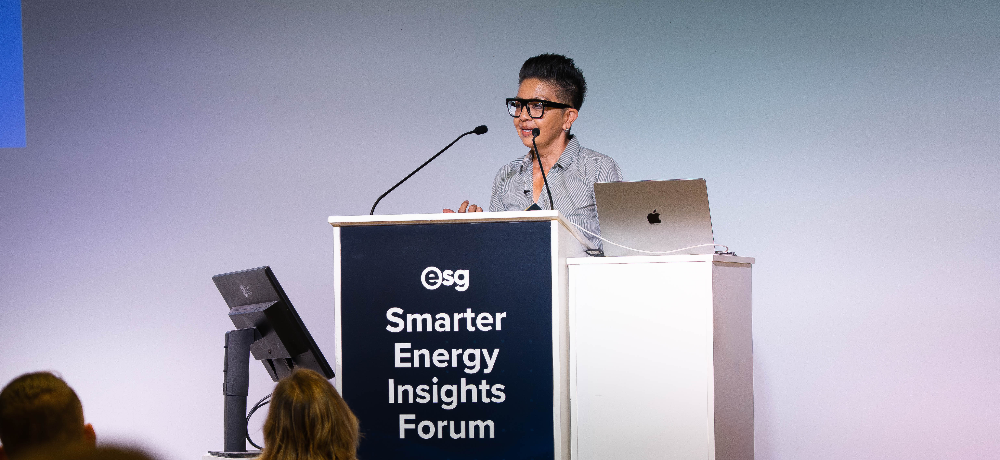
The Energy Digitalisation Framework is a joint consultation between government and Ofgem. Which is why it was important at the Smarter Energy Insights Forum 2026 that a senior Ofgem representative walked us through the regulatory roadmap. She began with one aim: making sure energy data can be exchanged, accessed and shared easily.
That sounds simple, and in principle it is. The complexity comes when you try to make it work across a system with layers on layers of history.
The roadmap was framed in two stages. The first was visibility. Over the past two or three price controls, Ofgem has funded network companies to install monitoring equipment so that operators can see what is happening on their systems. From the speaker’s perspective, we’re pretty much there.
The second stage, which is where the work is now, is exchangeability. It means being able to move data between organisations in a form that everyone can trust and use. Ofgem’s approach rests on three building blocks, and each has different implications for the industry.
The foundation is data best practices, a set of eleven principles for cleaning up data and making it attributable and shareable. A representative from The National Energy System Operator (NESO) later noted that these were published in 2021. This was described effort as a real turning point, because it was the first time the networks were clearly told to manage their data in line with agreed standards.
Building the governance teams, monitoring the processes and measuring quality all gave the sector something to build on.
Alongside this, Ofgem introduced a presumption that data is open unless there is a reason to close it. But this doesn’t mean all data is open.
Anything with a security, commercial or GDPR concern goes into a closed category. System-level data that needs additional security clearance sits in a separate bucket, and everything else is open. There was a rough estimate was that 10 to 15 percent of data will end up in the public domain.
The second block is the Data Sharing Infrastructure (DSI), which NESO covered in detail later in the morning. Once organisations sign up to the trust framework and clear the security requirements, they can see a catalogue of the data available and access what they have clearance for. Signing on doesn’t mean everyone gets access to everything.
The programme is moving from concept to delivery. Testing with synthetic data starts in November 2026, involving the network companies that signed up for the first phase. The infrastructure isn’t just for Ofgem and the networks. It’s intended for all stakeholders, and the initial small group is there to make sure the technology works before others join.
Some people had assumed DSI is only for network operators, and she corrected that firmly. It’s for everyone in principle, but it’s not designed for households, and it requires a degree of technical capability and a commitment to the trust framework. It’s a piece of infrastructure and won’t appear as an app.
The third block will matter most to anyone who deals with customers. The Consumer Consent Solution (CSS) will allow customers to give permission, in an open-banking style, for a third party to use their data. That third party might be consumer advocacy groups, price comparison sites, or companies offering to reduce their bills.
The Minimal Marketable Product (MMP) is due in March 2027. After that, Retail Energy Code Company (RECCo) will move on to integrating CSS with tariff interoperability. A clear strategy was laid out for encouraging adoption: rather than the regulator promoting consent, trusted intermediaries need to do it.
The Citizens Advice Bureau raised the idea for this kind of solution with Ofgem, and RECCo will test the MMP with them to make sure it is ready. Consumers who might not trust the regulator are far more likely to trust an organisation they already know. This is a long-term, ground-up strategy.
There was a good case for why the architecture itself matters. NESO, RECCo and Elexon have produced a first iteration of an architecture designed to be both interoperable and extensible, so that new digital solutions can join without being built in isolation.
It will go out for consultation this winter, and Ofgem stressed that they want hear the bad news as well as the good. It’s version one, and it’s meant to improve.
The domain coordinator roles need to fit tightly with a future digitalisation coordinator. The roadmap itself is easy to describe, but once you install something you have to look at every layer of the system and check that it connects. The domain coordinators are responsible for making sure data in their domain follows the standards.
The digitalisation coordinator, once established, will steward the whole system, making sure the right use cases come into the DSI and that the architecture can keep expanding.
NESO is currently the interim DSI coordinator, and Ofgem will consult on that role next year. For organisations that want influence, the message is to engage while the questions are still open.
One audience question challenged the whole premise. With so many organisations involved, isn’t there bound to be duplication, and how are all-in costs weighed against the benefits?
Firstly, in terms of scale. Studies have put the potential benefits of energy data in the hundreds of billions of pounds. If data sharing can optimise the system by 10 to 15 per cent, freeing up capacity and enabling more flexibility, the savings would run to billions.
Against that, there’s the cost of the DSI, which went through innovation funding, at roughly £10 million to £20 million. That’s a lot to an individual organisation, but modest next to the potential return.
Secondly, the caution involved. The real risk is unnecessary layers of governance and bureaucracy, and each extra layer adds cost. Care is being taken to build an efficient system and not merely a reasonably efficient one. As a NESO representative later added, benefits also depend on adoption. The DSI needs to become business as usual, a lived reality for all participants, or the value won’t materialise.
A real-world example: constraint costs run to billions of pounds, and companies that use available data to show customers where the constraints are, or where they can connect, are already saving them money. Connection and constraint data are the kind of information Ofgem wants to put into more hands.
Asked whether opt-out should be removed and half-hourly data mandated, the response was that issue shouldn’t be forced. Attempts in other geographical regions (such as California) to push smart meters on people haven’t worked well. Ofgem’s view is that the opt-out system is working, and that the priority is showing customers the value of data so that more people opt in.
A representative from The Smart Energy Code Company (SECCo) reinforced the point that trust is the underlying issue, and that consumers need to see that the systems are secure and that they have real choice.
Ofgem is the regulator and implements policy that comes from legislation. It was stated they have done the maximum it can on community energy, and that any further change depends on new legislation. Upcoming legislation is expected to provide some clarity, but peer-to-peer trading is perhaps a little premature, because customers need to be ready for it.
Three things stood out from this session.
First, the regulatory roadmap is more concrete than many people assume. The foundations (data best practice) are done, and the infrastructure and consent solution have real dates attached.
Second, the next few months hold several chances to influence outcomes, including the architecture consultation this winter and the consultation on the coordinator role next year. The people designing the system said clearly that they want input, including criticism.
Third, cost discipline is central to the regulator’s thinking. Duplicated effort, unnecessary governance and poorly adopted infrastructure are all seen as risks to the business case, so anything that reuses existing assets and joins up with other initiatives is likely to be well received.
At ESG, we will keep tracking each of these milestones. If you would like to discuss how they might affect your plans, please get in touch via LinkedIn. I would be glad to hear from you.